
Estevenson Coleman Comes Full Circle in Room B103
On an otherwise dreary Wednesday morning, Mrs. Delaney’s French 4/AP5 class was brightened by the return of Estevenson Coleman. A former SCW student and now the author of Three-Sixty, Coleman stepped into the room with an ease that made it feel as though no time had passed. Mrs. Delaney greeted her former student with open arms, pulling him into a warm embrace that spoke to years of shared history. To both students and onlookers, their connection felt unchanged—despite the many years since he had last sat in her classroom. With a beaming smile and a quick, witty remark in French, Coleman took his seat once again, returning not just as a visitor, but as someone who had once learned within those same walls.
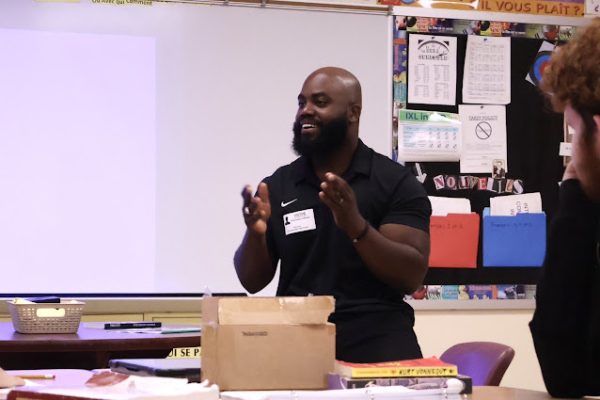
Estevenson Coleman speaking with Mrs. Delaney’s French class on April 15th, 2026.
Students were introduced to Estevenson Coleman, the Program Manager behind Brace for Impact 46, whose leadership is grounded in both experience and purpose. Originally from Haiti, his journey—from losing his parents at a young age to being adopted and rebuilding his life in the United States—has shaped the work he does today, coordinating programs that support communities both in St. Louis and abroad.
He recently captured that journey in his book Three Sixty: A Journey of Resilience and Gratitude, offering a personal look into the challenges he has faced and the perspective he has gained. That same resilience was evident in the way he spoke, giving students a glimpse into not just his career, but the story that continues to drive it. Below is a lightly edited and translated version of the conversation that followed.
Coleman described his book as more than just a story, emphasizing, He explained that including Creole phrases was intentional: “I wanted to integrate the reader into the culture… so that you didn’t have to guess,” adding, “Tu peux voir avec les yeux fermés.”
As the conversation turned to Haitian culture, Coleman shared one of the country’s most meaningful traditions. “The first of January is Independence Day in Haiti and we celebrate by drinking pumpkin soup,” he said, explaining that during the time of slavery, it was a meal reserved only for the French and slave masters. “So when we gained independence, we’re like ‘everybody’s gonna have that.’” Now, he explained, the tradition is rooted in community: “January 1st, you could go to anybody’s house and ask for a bowl of soup and they would give it to you.” Though he admitted he doesn’t always get to have it himself anymore, the significance of the tradition has stayed with him.
At the same time, Coleman reflected on the cultural differences he encountered when he arrived in the United States—some of which he now looks back on with humor. “Baby showers, definitely,” he said without hesitation, prompting laughter from the class. “Because when I arrived here I was 15 years old and my parents told me, ‘you must prepare, we are going to do a shower for you.’” Pausing, he added, “I thought it was so bizarre. ‘You’re going to give me a shower? What kind of tradition is this?’” Only later did he realize what it actually meant. “When I arrived… it was completely different than I had imagined it in my head. Now, I understand.”
That mix of humor and honesty continued as he described his journey to America. “It wasn’t complicated, it was more shocking,” he said, recalling a series of firsts—his first time on an airplane, his first time seeing a city lit up at night. “I arrived at night and everything was illuminated,” he explained. “In Haiti, everyone goes to sleep when the chickens go to the trees… because they know it’s getting dark.”
One of the most memorable stories, however, came when he described his first experience in an elevator. “It was like a box with one door,” he said, describing the moment in Miami when he and his family stepped inside with their luggage. “There were no windows and the door closed… I was like, ‘where are we?’” Drawing on rumors he had heard growing up, he admitted what he was really thinking in that moment: “People would say, ‘oh the white people are adopting you so they can sacrifice you later,’ so I was like, ‘alright… this is where it ends. I’m getting sacrificed today.’” As the elevator dropped and then began to rise, he added, “I was like, ‘well, we either go to hell or heaven, I don’t know.’” The class erupted in laughter as he described everyone inside avoiding eye contact, only for the doors to open with a simple “ding.” “We were on a whole different floor,” he said. “I was freaking out like, ‘what is going on?’ I thought they were going to register me for the military or turn me into a hamburger or something.”
Despite the laughter his stories brought, Coleman consistently returned to a message of resilience. When asked what advice he would give his younger self, he answered, “Ça va y aller… it’s going to work out.” He acknowledged how overwhelming difficult situations can feel, explaining that “sometimes you can’t see it,” but ultimately, “it’s going to work out.”
Mrs. Delaney later reflected on a moment that, for her, captured Coleman’s character even as a student. “I remember one time, Estevenson stopped my entire class because someone was sleeping,” she said. “He said, ‘I just don’t understand why you’re sleeping. You’re so lucky to be here… and you’re just completely taking it for granted.’” She paused before adding, “That was one of the most memorable moments in my 29 years of teaching. Needless to say, that kid never slept in class ever again.”
For Coleman, returning to the classroom brought back vivid memories of his own time as a student still learning English. “When I first came here, I didn’t speak English,” he shared. “I’ll tell you this in English because I couldn’t tell you back then, so I’m telling you now. Freedom, right?” He described sitting in the back of the classroom during lessons, working quietly while Mrs. Delaney taught, then receiving extra help whenever there was a pause. “Every time she would have a break… she’d come and explain the stuff to me,” he said.
He also emphasized the role of Miss Parrett and the coordination between teachers. “My teachers would work in coalition with Miss Parrett,” he explained. “The notes were going too fast for me, so she would give me the notes, and then I would go work in Mrs. Delaney’s classroom.” Between lunch periods, free time, and constant support, he added, “this classroom was probably the class I spent the most time in… this is history for me.”
That history made leaving even more difficult. “I was really sad to have ever left this place,” he admitted. On his last day, he went back to visit his teachers, remembering how emotional the moment became. “I couldn’t talk,” he said. “I felt like I had a rock in my throat.” Mrs. Delaney nodded, quietly adding, “Yeah, I remember that.” She then looked at him and said, “But look at all the good you’ve done.”
Now, years later, that moment feels full-circle. Smiling widely, Coleman reflected, “Every time you’re like, ‘Can you come speak to my class?’ I’m always so happy to come back and do that.” His book, Three-Sixty: A Journey of Resilience and Gratitude, is also available in the school library, giving students the chance to engage with his story in the very place where his own journey in education first took shape.
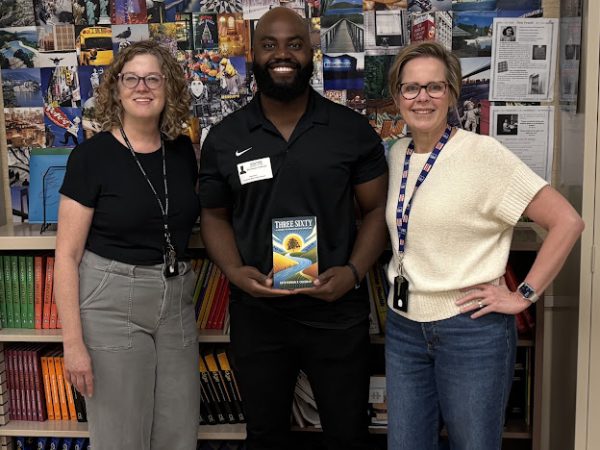
A full circle moment with Mrs. Allison Parrett (left), Estevenson Coleman (center), and Mrs. Amy Delaney (right).